
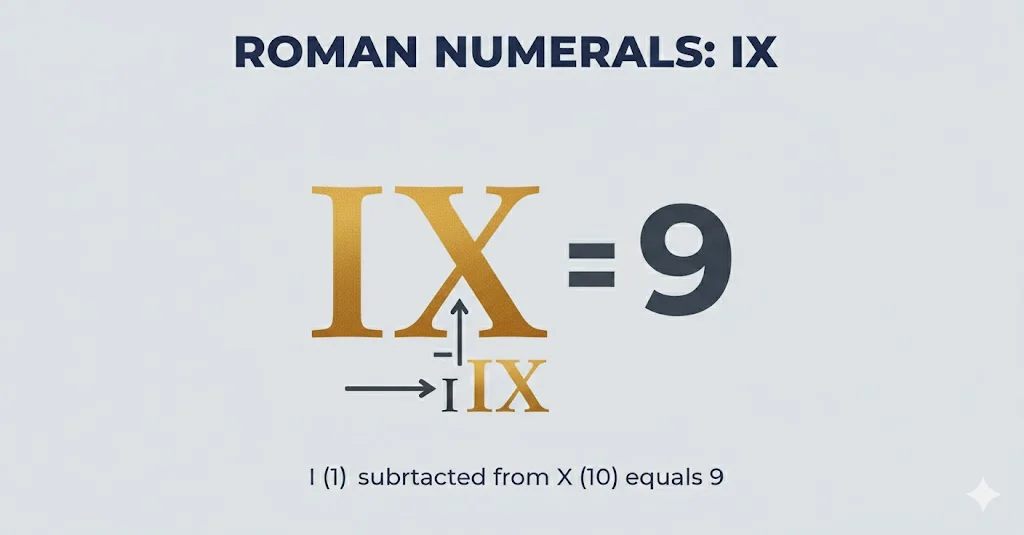

IX in Roman numerals means 9. It is formed by placing I (1) before X (10), which indicates subtraction, so the value is 10 minus 1 equals 9.
Roman numerals appear everywhere, from clocks and book chapters to movie titles and historical dates. Among them, IX is one of the most commonly seen yet frequently misunderstood combinations. At first glance, it might seem confusing, especially if you are new to Roman numerals or have only encountered simpler forms like I, V, or X.
In this guide, you will learn exactly what IX means in Roman numerals, how it is constructed, why it uses subtraction, and how it compares to similar numeral patterns. By the end, you will be able to read and use IX confidently in real world contexts.
What Does IX Mean in Roman Numerals?
In Roman numerals, IX represents the number 9.
This value comes from a basic Roman numeral rule called subtractive notation. When a smaller numeral appears before a larger one, its value is subtracted instead of added.
In this case:
- I = 1
- X = 10
Because I comes before X, the value becomes 10 minus 1, which equals 9.
Understanding the Symbols I and X
To fully understand IX, it helps to look at its individual parts.
Meaning of I
The Roman numeral I represents the number 1. It is the smallest and most basic numeral in the Roman system.
Meaning of X
The Roman numeral X represents the number 10. It is often used as a base for forming other numbers.
When these two symbols are combined correctly, they create the value 9.
Why IX Uses Subtraction Instead of Addition
At first, some learners expect 9 to be written as VIIII because V equals 5 and I equals 1. While that form did exist in very early Roman writing, it later fell out of favor.
Instead, Romans adopted subtractive notation to make numerals shorter and clearer.
Therefore:
- VIIII became IX
- XXXX became XL
- LXXXX became XC
As a result, IX became the standard and widely accepted way to write 9.
Roman Numeral Rules Behind IX
Roman numerals follow specific rules that explain why IX works the way it does.
Here are the key rules involved:
- A smaller numeral before a larger one means subtraction
- I can only subtract from V or X
- Subtractive pairs are limited to prevent confusion
- No numeral is repeated more than three times in a row
Because IX follows all these rules, it is considered correct and standard.
How IX Is Used in Real Life
You may encounter IX more often than you realize. It appears in many everyday and formal contexts.
Common Places You See IX
- Clock faces showing the number 9
- Book chapters or sections
- Movie sequels or series titles
- Historical dates written in Roman numerals
- Legal documents or outlines
In each of these cases, IX always represents the number 9.
Examples of IX in Context
Seeing IX used in sentences can make its meaning clearer.
Neutral Example
Chapter IX discusses the final phase of the project.
Formal Example
The event will take place on September IX in Roman numeral format.
Educational Example
Students learned that IX equals 9 using subtractive notation.
No matter the context, IX consistently refers to the same numeric value.
IX Compared to Similar Roman Numerals
Understanding IX becomes easier when you compare it with nearby numbers.
Roman Numerals Around IX
| Roman Numeral | Value |
|---|---|
| VII | 7 |
| VIII | 8 |
| IX | 9 |
| X | 10 |
| XI | 11 |
This table highlights how IX is the only one in this range that uses subtraction instead of addition.
IX vs VIII: A Common Point of Confusion
Many beginners mix up VIII and IX.
Here is a simple comparison:
| Numeral | Structure | Value |
|---|---|---|
| VIII | V plus three I | 8 |
| IX | X minus I | 9 |
Once you remember that subtraction is involved, the difference becomes much clearer.
Why IX Is Written Instead of VIIII
Although VIIII is technically readable, it is not considered standard today.
The preferred use of IX exists because:
- It is shorter
- It follows established Roman rules
- It reduces repetition
- It improves readability
As a result, IX is used almost universally in modern Roman numeral systems.
Alternate Meanings of IX
Outside of Roman numerals, IX can have other meanings depending on context.
For example:
- In gaming or media, IX may represent a sequel number
- In chemistry or coding, it can appear as an abbreviation
- In branding, it may be part of a name or symbol
However, when discussing numbers or historical notation, IX almost always means 9.
Helpful Tips for Remembering IX
If you struggle to remember Roman numerals, these tips can help.
- Think of IX as one step before X
- Remember that smaller before larger means subtraction
- Visualize 9 as almost 10 but missing one
- Practice reading numerals in order
With repetition, IX will quickly become second nature.
Frequently Asked Questions
1. What number does IX represent in Roman numerals?
IX represents the number 9.
2. Why is IX equal to 9?
Because I equals 1 and X equals 10, and placing I before X means subtraction.
3. Is IX ever written as VIIII?
While it existed historically, VIIII is not standard today. IX is the accepted form.
4. Can I subtract I from any numeral?
No. I can only subtract from V and X.
5. IX used on clocks?
Yes. Many traditional clocks use IX to represent 9.
6. Does IX ever mean anything other than 9?
Only outside of Roman numeral contexts. In numbers, it always means 9.
7. How do I read IX out loud?
It is read as “nine.”
8. IX used in modern writing?
Yes. It is still used in outlines, titles, dates, and design elements.
Conclusion
So, what does IX mean in Roman numerals? It means 9, created through subtractive notation by placing I before X.
To recap:
- IX equals 9
- It follows Roman numeral subtraction rules
- It is widely used in modern
- It replaces the older form VIIII
- It appears in clocks, books, and titles
Once you understand IX, reading Roman numerals becomes much easier. With a little practice, spotting and interpreting these symbols will feel simple and intuitive
Discover More Post
What Does Collated Mean in Printing? with Examples(2026)
What Does Faded Mean in Drugs? Slang Meaning Explained …
What Does a Red Card Mean in Soccer? Rules, Punishments …