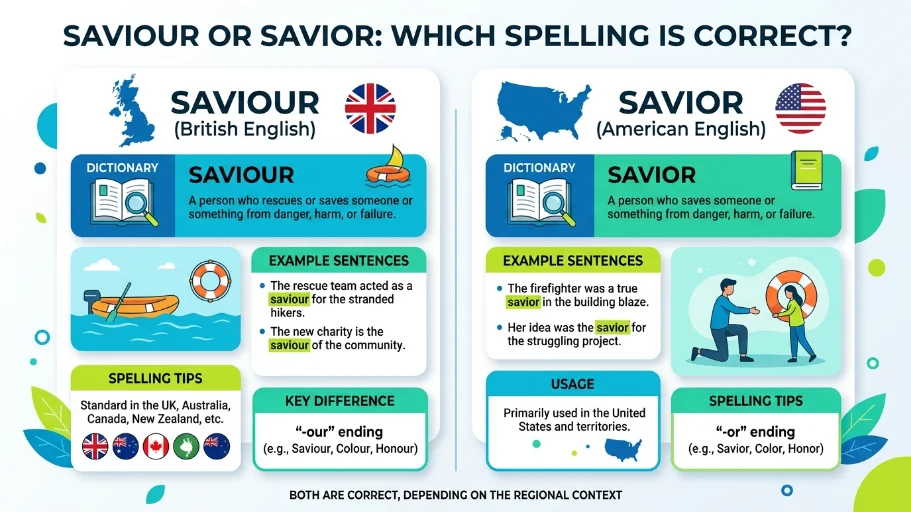

Both saviour and savior are correct spellings. Saviour is the preferred spelling in British English, while savior is the standard spelling in American English. The meaning is exactly the same, and the choice depends on the type of English you are using.
Many English learners search for saviour or savior because they notice two different spellings of the same word. Unlike some spelling mistakes, this is not a case of one word being right and the other being wrong. Both spellings are correct, but they are used in different regions of the world.
You might read saviour in a British newspaper and then see savior in an American article. This can be confusing, especially for students, writers, and professionals who want to use the correct spelling in their work.
The good news is that the difference between saviour or savior is simple. The meaning never changes. The only difference is the spelling preference based on British English and American English.
This guide explains the meaning of the word, its origin, regional usage, grammar rules, real-world examples, common mistakes, and tips to help you choose the correct spelling every time.
Quick Answer About Saviour or Savior
| Word | Correct? | Used In |
|---|---|---|
| Saviour | ✓ Yes | British English |
| Savior | ✓ Yes | American English |
Simple Rule
- Use saviour when writing in British English.
- Use savior when writing in American English.
What Does Saviour or Savior Mean?
The words saviour and savior are nouns. They refer to a person who saves someone from danger, difficulty, or a bad situation.
The word can also have a religious meaning, especially when referring to Jesus Christ in Christianity.
Dictionary Meaning
A saviour or savior is:
- A person who rescues someone.
- Someone who solves a serious problem.
- A person regarded as a helper or protector.
- A religious figure who brings salvation.
Examples
- The firefighter became the child’s savior.
- The doctor was considered a saviour by the community.
- Good weather was our savior during the trip.
Are Saviour and Savior Different Words?
No. They are the same word with different spellings.
The pronunciation is also the same:
/ˈseɪ.vjər/
The meaning, grammar, and usage remain identical.
The only difference is the regional spelling preference.
Why Are There Two Spellings?
English has many words that are spelled differently in British and American English.
Examples include:
| British English | American English |
|---|---|
| Colour | Color |
| Favourite | Favorite |
| Honour | Honor |
| Labour | Labor |
| Saviour | Savior |
The spelling difference comes from historical changes in English.
The History of Saviour and Savior
The word comes from the Latin word salvator, meaning “one who saves.”
Later, it entered French and then English.
British English kept the -our spelling in many words, while American English simplified many of these spellings to -or.
This is why we now have:
- Saviour and Savior
- Honour and Honor
- Neighbour and Neighbor
Both spellings are accepted today.
What Part of Speech Is Saviour or Savior?
Both words are nouns.
A noun names a person, place, thing, or idea.
Examples
- The lifeguard became our savior.
- She was the saviour of the project.
- The new software was a savior for the company.
Common Meanings of Saviour or Savior
A Rescuer
Someone who saves another person.
Example:
- The pilot became a hero and a savior.
A Problem Solver
Someone who solves a difficult problem.
Example:
- The mechanic was our saviour after the car broke down.
A Religious Figure
In Christianity, Jesus Christ is called the Savior or Saviour.
Example:
- Christians believe Jesus is their Savior.
Saviour or Savior in Everyday English
The word is often used figuratively.
Examples:
- Coffee was my savior during the long meeting.
- My phone charger was a saviour on vacation.
- The umbrella became our savior during the storm.
These examples do not involve actual rescue but describe something extremely helpful.
Saviour or Savior in Literature
Writers often use the word to describe heroes.
Examples:
- The knight became the saviour of the kingdom.
- The young girl was the savior of her family.
The word often creates a sense of hope and rescue.
Saviour or Savior in Business Writing
The word appears frequently in professional communication.
Examples:
- The new employee became the savior of the project.
- Automation was the company’s saviour during difficult times.
Business writers often use the word figuratively.
Saviour or Savior in Media and Journalism
Journalists use the term when discussing:
- Political leaders
- Athletes
- Emergency workers
- Innovators
Examples:
- The goalkeeper became his team’s savior.
- The doctor was hailed as a saviour.
British English vs American English
This is the biggest difference in saviour or savior.
British English
Preferred spelling:
Saviour
Countries that often use this spelling include:
- United Kingdom
- Australia
- New Zealand
- Pakistan
- India
American English
Preferred spelling:
Savior
Countries that often use this spelling include:
- United States
- American publications and businesses
Comparison Table: Saviour or Savior
| Feature | Saviour | Savior |
|---|---|---|
| Correct spelling | Yes | Yes |
| British English | Yes | Rare |
| American English | Rare | Yes |
| Meaning | Same | Same |
| Pronunciation | Same | Same |
Which Spelling Should You Use?
Choose the spelling based on your audience.
Use Saviour If:
- Writing for British readers.
- Following UK spelling rules.
- Writing for schools that teach British English.
Use Savior If:
- Writing for American readers.
- Publishing in the United States.
- Following American style guides.
The most important rule is to remain consistent throughout your writing.
Why Consistency Matters
Using both spellings in one article can look unprofessional.
Incorrect:
- The firefighter was our saviour. The next day our savior returned.
Correct:
- The firefighter was our saviour.
- The firefighter was our savior.
Choose one style and use it consistently.
Common Phrases With Saviour or Savior
- My savior
- Financial savior
- Unexpected savior
- National saviour
- Team savior
- Personal savior
- Community saviour
- Spiritual Savior
These phrases are common in everyday writing.
Synonyms of Saviour or Savior
- Hero
- Rescuer
- Protector
- Defender
- Champion
- Guardian
- Deliverer
Example
Instead of saying:
- He became our savior.
You could say:
- He became our hero.
Antonyms of Saviour or Savior
- Villain
- Enemy
- Opponent
- Threat
- Destroyer
These words describe people who create problems rather than solve them.
Common Mistakes With Saviour or Savior
Mistake One
Thinking one spelling is incorrect.
Correct:
Both spellings are acceptable.
Mistake Two
Mixing both spellings in one article.
Correct:
Choose one style and stay consistent.
Mistake Three
Changing the meaning.
Correct:
The meaning is identical regardless of spelling.
Saviour or Savior in Academic Writing
Most universities follow either British or American style guides.
Always check:
- Assignment instructions
- University guidelines
- Publication standards
Consistency is more important than the specific spelling.
Saviour or Savior in Religious Writing
In Christian texts, the word often appears with a capital letter:
- Jesus Christ is our Savior.
- Jesus Christ is our Saviour.
The capital letter shows that the word is used as a title.
Memory Trick for Remembering Saviour or Savior
Trick One
Think:
Britain loves “our.”
Therefore:
- Colour
- Honour
- Favourite
- Saviour
Trick Two
Think:
America likes shorter spellings.
Therefore:
- Color
- Honor
- Favorite
- Savior
Exercises With Answers
Choose the Correct Spelling for British English
- The firefighter became our ______.
Answer: Saviour
- The doctor was considered a ______.
Answer: Saviour
Choose the Correct Spelling for American English
- The nurse became a ______.
Answer: Savior
- The new software was our ______.
Answer: Savior
Correct the Sentences
Sentence
The savior of the team scored the winning goal. (British English)
Correct:
The saviour of the team scored the winning goal.
Sentence
The saviour of the project saved the company. (American English)
Correct:
The savior of the project saved the company.
Practice Sentences
Write your own sentences using:
- community savior
- personal saviour
- financial savior
- unexpected saviour
- national savior
Frequently Asked Questions
Which is correct, saviour or savior?
Both spellings are correct. The choice depends on whether you use British or American English.
Is saviour a real word?
Yes. It is the standard British English spelling.
Is savior a real word?
Yes. It is the standard American English spelling.
What is the difference between saviour and savior?
There is no difference in meaning or pronunciation. The only difference is regional spelling.
Should I use saviour or savior in academic writing?
Use the spelling required by your institution or style guide.
Which spelling is used in the United Kingdom?
The preferred spelling is saviour.
Which spelling is used in the United States?
The preferred spelling is savior.
Can I use both spellings in one article?
No. Choose one spelling style and remain consistent.
Is Savior capitalized in religious writing?
Yes, it is often capitalized when referring to Jesus Christ.
How can I remember the difference between saviour or savior?
Remember that British English usually keeps -our, while American English prefers -or.
Conclusion
The answer to saviour or savior is simple: both spellings are correct.
Saviour is the preferred spelling in British English, while savior is the standard spelling in American English. The meaning, pronunciation, and grammar remain exactly the same.
The key is to understand your audience and remain consistent in your writing. If you are writing for a British audience, use saviour. If you are writing for an American audience, use savior.
By learning the difference between these regional spellings, you can improve your writing, avoid confusion, and communicate more professionally in academic, business, and everyday situations.