

Have you ever stopped typing mid-sentence, stuck on whether to use “or” or “nor”? You are not alone. This tiny decision freezes native speakers, professionals, and students every single day.
Here is the problem. You are writing an email. You type, “I don’t have the report or the presentation.” Then you pause. Should it be “nor”? You Google it. You land here. Welcome. You will have your answer in the next two minutes.
This article works differently. You get the rule immediately. Then you dive as deep as you want, with clear examples, common mistakes, and practice exercises that actually stick. No fluff. Just the answer you came for, followed by everything else worth knowing.
Quick Answer and Visual Decision Chart
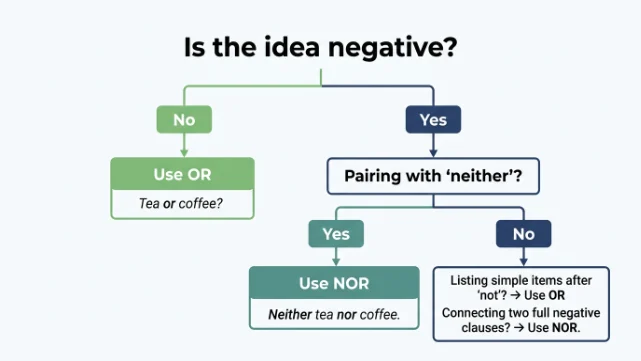
Before a single definition, here is your answer. Use this flowchart every time you freeze.
Should I use “or” or “nor”?
text
Is the idea negative?
│
├─ No → Use "or"
│     Example: Tea or coffee?
│
└─ Yes → Are you pairing with "neither"?
      │
      ├─ Yes → Use "nor"
      │     Example: Neither tea nor coffee.
      │
      └─ No → Are you listing simple items after "not"?
            │
            ├─ Yes → Use "or"
            │     Example: I don't have tea or coffee.
            │
            └─ No → Are you connecting two full negative clauses for emphasis?
                  │
                  └─ Yes → Use "nor" with inversion
                        Example: He did not call, nor did he write.
That is the entire rule in one chart. Bookmark this page. Return to this chart. It solves ninety-five percent of your real-world decisions.
Nor vs Or: The Core Difference in One Table
If the flowchart isn’t your style, here is the simplest possible comparison.
| Word | Function | Pairs With | Example |
|---|---|---|---|
| Or | Presents positive choices or alternatives | Either | Either Monday or Tuesday works. |
| Nor | Continues a negative idea | Neither | Neither Monday nor Tuesday works. |
The golden rule: “Either” dances with “or.” “Neither” dances with “nor.” Never mix these dance partners. Ever.
What Does “Or” Mean
“Or” is a coordinating conjunction. It connects words, phrases, or clauses that present alternatives. It says, “Here are options. Pick one or more.”
Common uses of “or”
Presenting choices between two items:
You can walk to the park or take the bus.
Listing possibilities:
She might be at the library, the gym, or the cafe.
Introducing a consequence:
Hurry up, or you will miss the train.
Connecting two independent clauses:
We can go to the movies, or we can stay home.
“Or” lives in the world of possibilities. It is the optimist of conjunctions.
What Does “Nor” Mean
“Nor” is also a coordinating conjunction, but it operates strictly in negative territory. Its job is to add another negative statement to one already made. It says, “Here is what is not true. And here is more that is not true.”
Common uses of “nor”
Paired with “neither”:
The restaurant serves neither meat nor dairy.
Continuing a negative idea after “not” or “never” (formal):
He does not smoke, nor does he drink.
Connecting multiple negative items in a list (literary/formal):
I have no time, no money, nor any desire to travel.
“Nor” eliminates the need to repeat a negative word. It efficiently extends the “no” across multiple elements.
The Most Googled Question: “Not…Or” vs “Not…Nor”
This is why you are here. You typed a sentence with “not” and got stuck. Here is the definitive answer.
Simple rule: When you have a single “not” or “never” and you are listing simple items, use “or.”
Correct and natural:
I don’t have a pen or paper.
She never calls or texts.
There wasn’t food or water.
When do you use “nor” after “not”? When you are connecting two full, negative clauses and you want emphasis or a formal tone.
Formal and emphatic:
He did not finish the report, nor did he attend the meeting.
She has never visited Paris, nor does she plan to.
There was no food in the fridge, nor was there any money.
Notice the structure: “nor + helping verb + subject.” This inversion is required. You cannot say “nor she does plan to.” You must say “nor does she plan to.”
Bottom line: For simple lists after “not,” stick with “or.” It is almost always correct and sounds natural. Reserve the “not…nor” clause structure for formal writing when you want to create a deliberate, emphatic rhythm.
Using “Nor” Without “Neither”
Can “nor” appear without “neither”? Yes, and we just covered the most important case. Here is a quick recap with more examples.
When a sentence already contains a negative word like “not,” “never,” “no,” or “nobody,” you can use “nor” to introduce a second negative clause. This is formal.
The company did not apologize. Nor did it offer compensation.
I have never seen such courage, nor do I expect to again.
Nobody knew the answer, nor did anyone volunteer to find it.
In casual speech and writing, most people would say “and…didn’t” instead. “The company didn’t apologize, and it didn’t offer compensation.” Both are correct. Choose based on your audience.
Real-World Examples by Context
Using Nor and Or in Professional Emails
Business writing demands clarity. Misusing these words can create a subtle impression of carelessness.
Client communication
We cannot process your request without proper documentation or valid identification.
Here, “not” applies to the whole phrase. “Or” correctly connects the two required items. Using “nor” would sound overly formal and possibly odd.
Declining politely
I’m afraid neither Tuesday nor Wednesday works for me.
The “neither…nor” construction is perfectly professional and crisp.
Setting boundaries
The policy does not cover theft or accidental damage.
Again, simple list after “not.” Use “or.”
Formal denial with emphasis
The vendor did not deliver the files on time, nor did they respond to our follow-up emails.
This is where “nor” shines in business. It adds weight to the second, compounding failure.
Using Nor and Or in Academic Writing
Academic prose values precision and often employs “nor” for its emphatic negation.
Research papers
The experiment yielded neither significant improvement nor measurable decline.
Clean, balanced, and leaves no ambiguity.
Literary analysis
The protagonist does not find redemption, nor does she seek it.
The “nor” clause deepens the analysis with a formal, rhythmic parallel.
Thesis statements
This study considers neither the economic nor the political implications.
Direct and space-efficient.
Logical Nor vs Or for Technical Writers and Programmers
This is a distinct, high-intent search. If you landed here looking for the logical operators, welcome.
In Boolean logic and programming, “or” and “nor” are distinct gates.
- OR: Returns true if at least one input is true.
- NOR: Returns true only if all inputs are false. It is the negation of OR.
Truth table
| Input A | Input B | A OR B | A NOR B |
|---|---|---|---|
| True | True | True | False |
| True | False | True | False |
| False | True | True | False |
| False | False | False | True |
In programming languages, OR is often written as || (e.g., C, Java, JavaScript) or or (e.g., Python). NOR is typically constructed by negating an OR expression: !(A || B) or not (A or B).
In natural language, “neither A nor B” directly expresses the logical NOR. “I want neither coffee nor tea” is logically equivalent to “NOT (coffee OR tea).”
Subject-Verb Agreement with Nor and Or
A hidden trap. When “or” or “nor” connects two subjects, which verb form do you use?
The Proximity Rule
The verb agrees with the subject closest to it. This is non-negotiable in standard English.
With “or”
Either the manager or the employees are responsible.
Either the employees or the manager is responsible.
With “nor”
Neither the CEO nor the board members were aware.
Neither the board members nor the CEO was aware.
When It Sounds Awkward
“Neither the students nor the teacher was happy” is grammatically correct but sounds unnatural. The fix is simple. Rewrite the sentence.
Instead of the awkward version, try:
The teacher was not happy, and neither were the students.
Or: The students were not happy, and neither was the teacher.
Never sacrifice readability for grammatical purity. A good writer rewrites.
Common Mistakes and Their Quick Corrections
This section is pure SEO gold because it matches exactly how you search when you are stuck. Each mistake below is a question someone has typed into Google.
Is “I don’t want neither” correct?
No. This is a double negative and is nonstandard.
Incorrect: I don’t want neither coffee nor tea.
Correct: I want neither coffee nor tea.
Also correct: I don’t want coffee or tea.
Is “either…nor” ever correct?
No. Never mix “either” with “nor.”
Incorrect: Either the red shirt nor the blue one fits.
Correct: Either the red shirt or the blue one fits.
Is “neither…or” ever correct?
No. Never mix “neither” with “or.”
Incorrect: Neither the laptop or the tablet works.
Correct: Neither the laptop nor the tablet works.
Can I use “nor” to start a sentence?
Yes, if it logically follows a negative statement.
Correct: He did not complain. Nor did he offer any solutions.
This is a powerful rhetorical device. Use it sparingly.
Do I need a comma before “nor”?
When “nor” connects two independent clauses (full sentences), use a comma.
Correct: He did not arrive on time, nor did he apologize.
When “nor” connects two simple items, no comma.
Correct: Neither rain nor snow stopped the mail.
What is the correct word order after “nor”?
When “nor” introduces an independent clause, invert the subject and helping verb.
Incorrect: He did not call, nor he wrote.
Correct: He did not call, nor did he write.
Which is correct: “I don’t have a pen or paper” or “I don’t have a pen nor paper”?
“I don’t have a pen or paper” is the standard, natural choice. “I don’t have a pen nor paper” is generally considered nonstandard. For the “nor” construction, you would say “I have neither a pen nor paper.”
Is it acceptable to use “nor” in casual conversation?
Grammatically, yes. Socially, it can sound stiff. Most native speakers say “I don’t like coffee or tea.” Saying “I like neither coffee nor tea” is clear but formal. Heavy use of “nor” in casual chat can sound pretentious. Know your audience.
Exercises with Instant Answers
Practice is how this rule becomes automatic. Complete each exercise. The answer follows immediately so you can check without scrolling. No friction.
Exercise 1: Fill in the Blank
Question 1: She doesn’t like apples _____ bananas.
Answer: or
Simple list after “doesn’t.” Use “or.”
Question 2: Neither the teacher _____ the students were in the room.
Answer: nor
“Neither” always pairs with “nor.”
Question 3: You can pay with cash _____ credit card.
Answer: or
Positive choice between two options.
Question 4: He will not apologize, _____ will he admit any fault.
Answer: nor
Formal clause connection after “not.” Note the inversion “will he.”
Question 5: I haven’t seen the movie _____ read the book.
Answer: or
Simple list after “haven’t.”
Question 6: Either we leave now _____ we wait another hour.
Answer: or
“Either” always pairs with “or.”
Question 7: The software is neither fast _____ reliable.
Answer: nor
“Neither” always pairs with “nor.”
Question 8: There was no food in the house, _____ any clean dishes.
Answer: nor
Formal continuation of the negative “no.” “Or” would also be acceptable in less formal writing.
Exercise 2: Correct the Error
Question 1: Either the director nor the producer approved the script.
Answer: Either the director or the producer approved the script.
“Either” pairs with “or.”
Question 2: I don’t need no help or advice.
Answer: I need neither help nor advice. (Or: I don’t need any help or advice.)
Double negative removed.
Question 3: Neither the cats or the dog has been fed.
Answer: Neither the cats nor the dog has been fed.
“Neither” pairs with “nor.”
Question 4: She did not call, nor she texted.
Answer: She did not call, nor did she text.
Inversion required after “nor” introducing a clause.
Question 5: He wants neither cake or ice cream.
Answer: He wants neither cake nor ice cream.
“Neither” pairs with “nor.”
Exercise 3: Choose the Correct Verb
Question 1: Neither the manager nor the employees (was / were) informed.
Answer: were
“Employees” is plural and closest to the verb.
Question 2: Either the blue pen or the black pen (is / are) fine.
Answer: is
Both subjects are singular.
Question 3: Neither the students nor the professor (understands / understand) the problem.
Answer: understands
“Professor” is singular and closest to the verb.
Question 4: Either the dogs or the cat (needs / need) to go out.
Answer: needs
“Cat” is singular and closest to the verb.
Question 5: Neither the report nor the appendices (contains / contain) the data.
Answer: contain
“Appendices” is plural and closest to the verb.
Frequently Asked Questions
What is the main difference between nor and or?
“Or” presents positive alternatives. “Nor” continues a negative idea. “Either or, neither nor” is the fundamental mnemonic.
What is the rule for nor vs or after “not”?
For simple lists after “not,” use “or” (I don’t have a pen or paper). For formal, emphatic clauses, use “nor” with subject-verb inversion (He did not call, nor did he write).
Can I start a sentence with nor?
Yes. “He did not complain. Nor did he offer any suggestions.” This is formal and emphatic.
Is “neither…or” ever correct?
No. It is always wrong. The correct pair is “neither…nor.”
Is “either…nor” ever correct?
No. It is always wrong. The correct pair is “either…or.”
Can I use nor without neither?
Yes. When another negative word like “not” or “never” is present, you can use “nor” to connect a formal, inverted clause. “She does not eat meat, nor does she consume dairy.”
Why does “nor” sometimes invert the subject and verb?
When “nor” introduces an independent clause, subject-verb inversion is grammatically required. “He did not go, nor did he call” is standard. “He did not go, nor he called” is incorrect.
What is the verb agreement rule for nor and or?
The proximity rule applies. The verb agrees with the subject nearest to it. “Neither the students nor the teacher was ready.”
Do I say “neither or” or “neither nor”?
Always “neither nor.” “Neither or” is a common error and is always incorrect.
Which is correct: “I don’t have a pen or paper” or “I don’t have a pen nor paper”?
“I don’t have a pen or paper” is the standard, natural form. “I don’t have a pen nor paper” is nonstandard. Use “I have neither a pen nor paper” if you want to use “nor.”
Conclusion
You now have the complete guide to “nor vs or.” Here is what matters most.
The two-minute rule: “Either” goes with “or.” “Neither” goes with “nor.” For simple lists after “not,” use “or.” For formal, emphatic negative clauses after “not,” use “nor” with inversion. That is it.
Return to the flowchart at the top whenever you freeze. Bookmark it. It solves almost every real-world decision you will face.
Precision in this tiny word choice signals precision in your thinking. In professional emails, academic papers, and published writing, getting “nor vs or” right removes a subtle friction from your reader’s experience. Your message lands cleanly. Your credibility holds. That is worth the few minutes you spent here today.