
You are planning a trip to Florence. You have dreamed of the Duomo, the Uffizi, and the Ponte Vecchio. Then a practical question stops you cold. “But what is the weather actually like?”
You Google “Florence weather.” You get a generic 10-day forecast. That doesn’t help you plan a trip three months from now. Or you search “Florence or weather” trying to figure out if you should prioritize weather over crowds, or spring over fall. You need the real picture. Not just temperatures. You need to know when you will melt in a piazza with no shade, when you will stand in a two-hour museum line in the rain, and when you will experience the city at its absolute perfection.
This guide gives you that. No fluff. Just an honest, month-by-month breakdown from someone who knows the difference between a sunny Florentine postcard and the humid reality of an August afternoon. By the end, you will know exactly which month matches your travel style.
Quick Answer and Visual Decision Chart
Before the detailed breakdown, use this flowchart. It matches your travel priorities to the right month.
text
What matters most to you?
│
├─ Perfect weather for walking and outdoor cafes
│  └─ April, May, late September, October
│
├─ Fewest crowds, lowest prices, and you don't mind a coat
│  └─ November, January, February (skip Christmas week)
│
├─ I want the classic sunny Tuscan summer experience, heat is fine
│  └─ June and July (but book air conditioning)
│
├─ I am on a strict budget and can handle unpredictable rain
│  └─ Late October, November, early March
│
└─ I must see Florence during the holidays, weather is secondary
   └─ December (book everything months ahead)
Florence has two sweet spots. Spring (April to May) and fall (September to October). These months offer daytime temperatures between 60 and 75 degrees Fahrenheit, manageable crowds, and the city at its most livable. If you can only remember one thing, remember that.
Florence Climate at a Glance: One Table to Rule Them All
Here is the entire year in one table. Scan it. Find your month. Then read the detailed breakdown below.
| Month | Avg High (°F) | Avg Low (°F) | Rainy Days | Crowd Level | Overall Verdict |
|---|---|---|---|---|---|
| January | 52 | 36 | 7 | Low | Cold but quiet. Good for budget solo travel. |
| February | 55 | 38 | 7 | Low | Similar to January. Slightly brighter. |
| March | 61 | 42 | 8 | Medium | Unpredictable. Layers essential. |
| April | 67 | 47 | 9 | Medium-High | The first sweet spot. Beautiful light. |
| May | 76 | 54 | 8 | High | Arguably perfect. Warm, not hot. |
| June | 84 | 60 | 6 | High | Summer begins. Hot afternoons. |
| July | 90 | 65 | 4 | Peak | Hot, crowded, expensive. A/C is non-negotiable. |
| August | 90 | 65 | 5 | Peak (locals leave) | Hottest month. Many local shops closed. |
| September | 81 | 59 | 7 | High | The second sweet spot. Warm days, cooler nights. |
| October | 70 | 51 | 9 | Medium-High | Crisp, golden light. Rain increases. |
| November | 59 | 42 | 11 | Low | Wettest month. Moody and atmospheric. |
| December | 52 | 37 | 9 | High (holidays) | Cold, festive, expensive. Magic or madness depending on you. |
What “Florence or Weather” Actually Means: Decoding the Search
Here is the thing. When people type “Florence or weather” into Google, they are rarely comparing two random words. They are usually asking one of three questions.
Question 1: “Should I visit Florence, or should I prioritize good weather and go somewhere else?”
Answer: You can have both. Pick April, May, late September, or October. Florence in perfect weather is unbeatable. Don’t settle. Just time it right.
Question 2: “Should I go to Florence in [month] or will the weather ruin it?”
Answer: Read the month-by-month breakdown below. There is no universally bad month. There is only the wrong month for your specific tolerance of heat, cold, and rain.
Question 3: “Florence weather now vs. Florence weather when I’m planning to go.”
Answer: You probably landed here from a general weather search. The 10-day forecast is useful for packing. The climate guide below is useful for planning. You need both.
Month-by-Month Florence Weather and Travel Guide
Florence Weather in January
January is Florence at its quietest and coldest. Daytime highs hover around 52°F. Nights drop to 36°F. Frost is possible in the early morning.
You will see Florence stripped of tourist crowds. The Uffizi Gallery feels like a private collection. You can stand alone in front of Botticelli’s Venus. That is the trade. You endure cold fingers and gray skies for an intimate experience that summer visitors cannot buy.
Rain falls about seven days during the month. It is not a downpour. It is a persistent, damp drizzle. Pack a waterproof coat, a scarf, and layered wool sweaters. Restaurants are cozy. Hot chocolate in a cafe on Piazza della Repubblica while the windows fog up is a core memory waiting to happen.
January verdict: Best for budget travelers and art lovers who hate crowds. Not for sun-seekers.
Florence Weather in February
February is January with slightly more light. The average high climbs to 55°F. The low sits at 38°F. The city begins to stir, but only slightly.
The almond trees sometimes bloom in late February, a surreal splash of pink against gray stone. This is still firmly off-season. Hotel prices remain low. Restaurant availability is instant. You will still need that heavy coat.
Carnivale sometimes falls in February, bringing masks, costumes, and a festive energy that cuts through the chill. If your dates align, it is a bonus.
February verdict: Still cold. Still quiet. A hidden gem for the right traveler.
Florence Weather in March
March is the wild card. The average high reaches 61°F, but the range is maddening. You could get a 70-degree day of pure sunshine. You could get three days of cold rain. You will probably get both.
Pack for everything. A light waterproof jacket, a warm mid-layer, and sunglasses. Do not trust the forecast a week out. Florentine March weather changes its mind hourly.
Crowds begin to build in the second half of the month, especially if Easter falls in March. Prices start to climb. The city wakes up. Outdoor cafes set up their tables, then pull them back inside when a shower rolls through.
March verdict: A gamble. Great if you win, manageable if you lose.
Florence Weather in April
April is the first true sweet spot. The average high is 67°F. The low is 47°F. The light is soft and golden on the Renaissance stone. Wisteria drapes over walls in cascades of purple. The city is in bloom, literally and metaphorically.
This is when Florence starts to feel like the postcard. You can eat lunch outside without sweating. You can climb Giotto’s Bell Tower without heatstroke. You need a light jacket for evenings.
The downside: Easter often brings massive crowds. If Easter falls in April, book accommodations at least four months ahead. The week after Easter is much quieter. Rain falls about nine days, but it tends to be light and passing.
April verdict: Magical. One of the two best months. Just manage Easter expectations.
Florence Weather in May
May is arguably perfect. The average high hits 76°F. Humidity is still low. The evenings are cool enough for a blazer but warm enough for a late-night gelato on the cathedral steps.
The countryside around Florence is an impossible green. Day trips to Tuscan hill towns are at their visual peak. The sun sets late, giving you long, golden evenings. This is when you understand why people fall in love with Italy and never leave.
Crowds are now high. Prices are high. The secret is out. Book everything well in advance. The weather is so good that the trade-off feels worth it.
May verdict: The best overall month. Warm, not hot. Crowded, but worth it.
Florence Weather in June
Summer arrives. The average high is 84°F. The afternoons are genuinely hot. Walking through the exposed Piazza della Signoria at 2 PM feels like crossing a stone desert.
The saving grace is the low humidity compared to July and August. Mornings and evenings are still pleasant. This is the month for a strategic siesta. Sightsee early. Eat a long lunch in an air-conditioned trattoria. Rest. Head out again after 5 PM.
Tourist numbers peak. The queues for the Duomo and the Accademia snake around blocks. Buy skip-the-line tickets for everything.
June verdict: The last manageable summer month. Beautiful if you pace yourself.
Florence Weather in July
July is hot. The average high is 90°F, and it feels hotter on the sun-baked streets. Humidity climbs. The air is thick. Air conditioning is not a luxury; it is a survival requirement. Verify your accommodation has it before booking.
The upside: Rain is rare. About four rainy days all month. The sky is a permanent, hazy blue. Evenings are alive. Everyone stays out late because it is finally comfortable.
Crowds are at their absolute peak. Prices are at their maximum. If you visit in July, embrace the chaos. Book everything months in advance. Start your days at dawn. Take the midday break seriously.
July verdict: For heat-tolerant extroverts only. Not for the faint of heart.
Florence Weather in August
August is July’s twin in temperature, but with a crucial cultural difference. It is the Italian holiday month. Many local shops, family-run restaurants, and non-tourist businesses close for two weeks, usually around Ferragosto on August 15.
The city becomes a strange mix of packed tourists and absent locals. You lose some of the authentic Florentine rhythm. What you gain is slightly thinner crowds in residential neighborhoods.
It is still 90°F. It is still humid. Do not underestimate this. The heat is relentless.
August verdict: The toughest month. Visit only if your schedule demands it, and book a hotel with a pool.
Florence Weather in September
September is the second sweet spot, and for many, it edges out May. The average high drops to 81°F. The oppressive humidity breaks. The light shifts to a softer, autumnal gold. Evenings in the mid-50s feel refreshing after the summer.
Crowds remain high in the first half of the month. By late September, they begin to thin. This is a wonderful time for day trips. The Chianti vineyards are heavy with grapes. The countryside is golden and hazy.
Rain picks up slightly, with about seven wet days. Pack a light rain jacket. It won’t spoil the trip.
September verdict: A strong contender for the best month. Warm days, cool nights, peak beauty.
Florence Weather in October
October delivers crisp, golden days and cool evenings. The average high is 70°F. The low is 51°F. You need a proper jacket at night. You can still enjoy a sunny lunch outdoors.
The autumn light in Florence is famous for a reason. It makes everything look like a Renaissance painting. The hills turn shades of ochre and rust. Truffle season begins. Mushroom dishes appear on menus.
Rain increases to about nine days. It can be a serious, steady rain. Do not let it deter you. A rainy day in Florence means ducking into a warm, wood-paneled enoteca for a glass of Chianti. That is not a hardship.
October verdict: Atmospheric and beautiful. The best choice for food and wine lovers.
Florence Weather in November
November is the wettest month in Florence. Eleven rainy days on average. The temperature drops to a high of 59°F and a low of 42°F. The crowds vanish. The city feels moody, quiet, and introspective.
This is the month for museum marathons and long, slow dinners. You will spend more time indoors. That is a feature, not a bug, if you plan accordingly. The art is inside. The food is inside. You just need a good raincoat and waterproof shoes.
Hotel prices plummet after the first week. Flights are cheap. If you want to see Florence on a budget and don’t mind gray skies, November delivers.
November verdict: Budget-friendly and atmospheric. Demands a positive attitude about rain.
Florence Weather in December
December is cold, festive, and complex. The high is 52°F. The low is 37°F. The first half of the month is wonderfully quiet and affordable. Then Christmas approaches, and the city transforms.
The Christmas markets in Piazza Santa Croce bring German-style wooden stalls, mulled wine, and twinkling lights. The city is decorated beautifully. It is also packed and expensive from about December 22 through New Year’s.
New Year’s Eve in Florence is raucous and crowded. Fireworks over the Arno are spectacular. If you want the festive magic without the peak prices, visit in the first three weeks of December.
December verdict: A tale of two months. Quiet and affordable early, festive and expensive late.
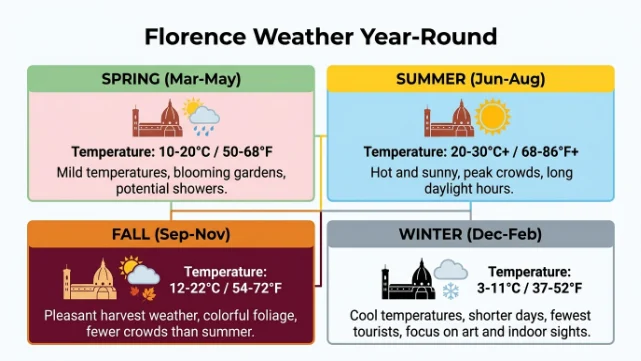
Seasonal Comparison: Florence Weather Face-Off
Sometimes you know your season but not your month. Here is how they stack up.
| Feature | Spring (Mar-May) | Summer (Jun-Aug) | Fall (Sep-Nov) | Winter (Dec-Feb) |
|---|---|---|---|---|
| Temperature | 55-75°F | 75-90°F | 50-80°F | 35-55°F |
| Rain | Moderate | Low | Moderate-High | Moderate |
| Crowds | Medium to High | Peak | High to Low | Low (except holidays) |
| Prices | Rising to High | Peak | High to Low | Low (except holidays) |
| Best For | Gardens, walking, balance | Sun, long evenings, energy | Food, wine, atmosphere | Art, budget, solitude |
| Pack | Layers, rain jacket | Light clothes, sun protection | Layers, rain jacket | Heavy coat, scarf, waterproof shoes |
Common Mistakes and Their Quick Corrections
This section addresses the real questions that bring people to this page.
Is Florence too hot in July and August?
Yes, for many people. The average high is 90°F, and humidity makes it feel hotter. The stone streets radiate heat. If you are sensitive to heat, choose June or September instead. If you must visit in July or August, book air conditioning, start days early, and rest during the afternoon.
Does it rain a lot in Florence in November?
Yes. November is the wettest month, averaging eleven rainy days. It is not tropical downpour rain. It is persistent, drizzly, gray rain. Bring waterproof shoes and a good coat. Plan indoor activities.
Can I visit Florence in winter and still enjoy it?
Absolutely. The art is indoors. The restaurants are cozy. The crowds are minimal. You just need warm clothes and realistic expectations about the weather. A rainy winter day in the Uffizi beats a sunny day at work.
Do I need air conditioning in Florence in June?
Yes. By mid-June, afternoons are hot. Verify that your accommodation has air conditioning. Do not assume it. Some older buildings and budget options do not. Read reviews specifically mentioning A/C performance.
What is the best month for a honeymoon in Florence weather-wise?
May or late September. Romantic temperatures, beautiful light, long evenings, and the city at its most photogenic. Avoid the peak summer heat if you want to dress nicely and walk comfortably.
Is Florence weather in March warm enough for outdoor dining?
Sometimes. Daytime highs average 61°F, but it varies. A sunny March day is lovely for lunch outside. A cloudy, windy day is not. Pack layers and have backup indoor options.
Does Florence get snow?
Rarely. A light dusting is possible in January or February, but it is uncommon and usually melts quickly. Do not plan a ski trip to Florence. The city shuts down dramatically even in a light snowfall, which is charming and chaotic in equal measure.
What to Pack for Florence Weather by Season
This is the practical section. Use it.
Spring Packing List (March to May)
- Light waterproof trench coat or rain jacket
- Sweaters and long-sleeve shirts for layering
- Comfortable waterproof walking shoes (cobblestones are slick when wet)
- Sunglasses
- Umbrella (compact and sturdy)
- Scarf (for warmth and style)
Summer Packing List (June to August)
- Lightweight, breathable clothing (linen, cotton)
- Sun hat and sunglasses
- High-SPF sunscreen (the Tuscan sun is strong)
- Comfortable sandals and one pair of closed walking shoes
- Light scarf or shawl for covering shoulders in churches
- Refillable water bottle (Florence has free public water fountains)
Fall Packing List (September to November)
- Mid-weight jacket or coat (heavier for November)
- Waterproof rain jacket and umbrella
- Layers (long-sleeve shirts, light sweaters)
- Waterproof shoes or boots (essential for November)
- Scarf and gloves for late November
Winter Packing List (December to February)
- Heavy, warm coat
- Waterproof boots or shoes
- Wool sweaters, scarves, gloves, hat
- Thick socks
- Lip balm and moisturizer (cold wind and indoor heating dry skin)
Frequently Asked Questions
What is the best month to visit Florence for good weather?
May and September offer the best balance of warm, pleasant temperatures and manageable rain. Both months feature beautiful light and comfortable conditions for walking and outdoor sightseeing.
How hot does Florence get in the summer?
July and August average highs of 90°F, with high humidity. Heatwaves can push temperatures above 95°F. The stone streets and piazzas retain heat, making mid-afternoon uncomfortable for many visitors.
Is Florence weather in October still good?
Yes. October averages a comfortable 70°F during the day. Evenings are cool. Rain increases, but sunny days are still common. The autumn light is famous and beautiful.
Does Florence have a rainy season?
November is the wettest month, with an average of eleven rainy days. October and December also see significant rain. July is the driest month.
What is the coldest month in Florence?
January is the coldest month, with average lows of 36°F and highs around 52°F. Frost is possible at night. Snow is rare.
Can I eat outside in Florence in April?
Yes, on most days. Daytime temperatures average 67°F. Evenings are cooler, so bring a jacket. Many restaurants set up outdoor seating by mid-April.
Is Florence weather suitable for a Christmas trip?
Yes, if you enjoy cold, festive atmospheres. December temperatures range from 37°F to 52°F. The city is beautifully decorated. Pack warm clothes and book holiday weeks far in advance.
When does Florence get the fewest tourists?
January and February have the lowest tourist numbers. November (outside of Thanksgiving week) and early December are also quiet. These months offer lower prices and a more local experience.
Does humidity make Florence feel hotter in summer?
Yes. The Arno River valley traps humidity. A 90°F day can feel much hotter, especially in the city center with limited shade and breeze. Stay hydrated and take breaks.
Is the weather in Florence the same as the Tuscan countryside?
Generally, yes, but the countryside can be slightly cooler at night and windier on hilltops. The city retains more heat due to stone buildings and pavement. Forecasts are broadly interchangeable for planning.
Conclusion
You came here searching “Florence or weather” because you needed clarity. Here it is.
Florence does not have a bad month. It has months that match your travel style and months that fight against it. The sweet spots are April, May, late September, and October. These months offer the city at its most beautiful, with temperatures that invite you to walk, explore, and linger.
Summer is hot and crowded, but the energy is electric. Winter is cold and quiet, but the art is empty and the restaurants are cozy. November is rainy and moody, but the budget traveler finds paradise.
The right month is the one that aligns with your tolerance for heat, cold, rain, and crowds. Check the flowchart at the top. Scan the table. Pick your month. Book your trip. Florence, in any weather, is Florence. That means it is worth it.