
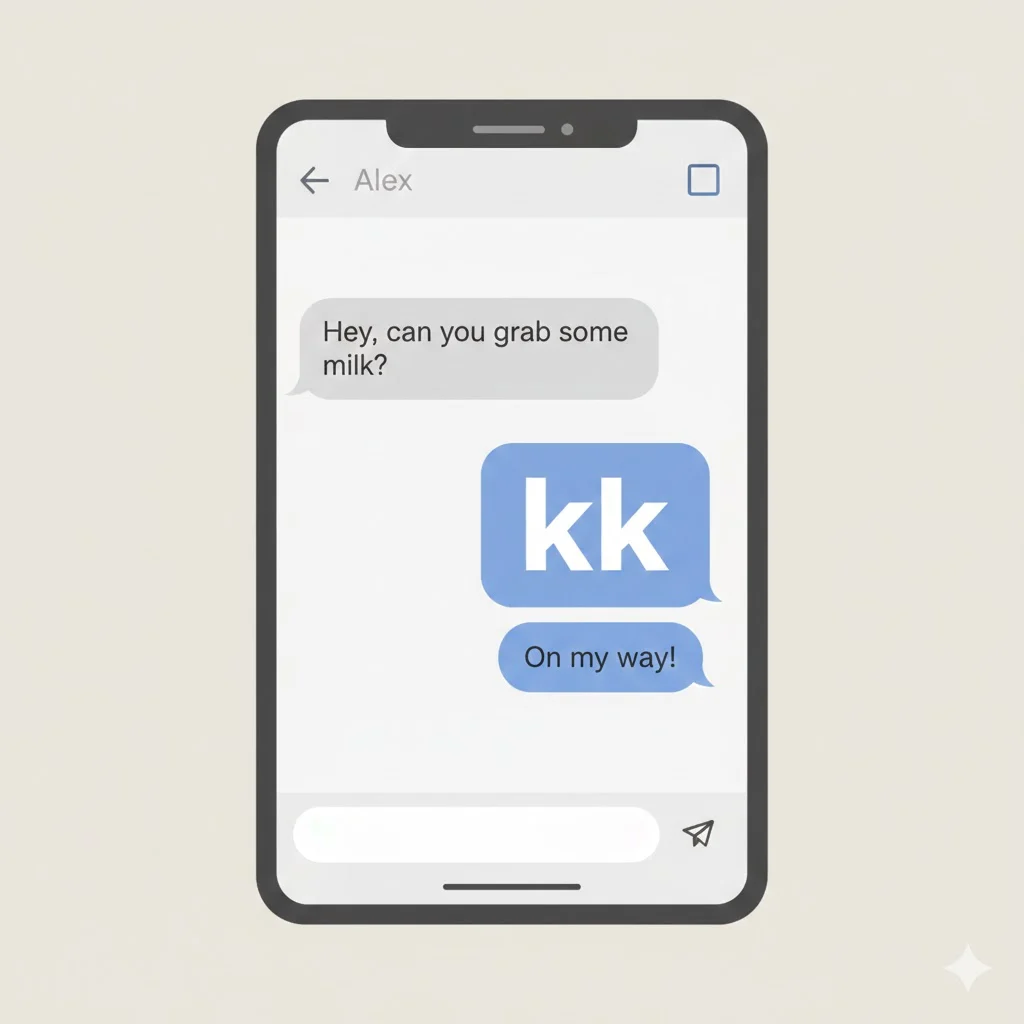

KK in a text message means “okay” or “got it.” It is a casual, informal response used to acknowledge a message, confirm understanding, or agree without adding extra emotion or detail.
Texting has its own language, and sometimes the shortest replies cause the most confusion. One of the most common examples is “kk.” You might see it in chats with friends, coworkers, or even someone you are dating and wonder what tone it carries.
Does kk mean someone is annoyed? Is it rude? Or is it just a fast way of saying okay?
In this guide, you will learn what kk means in a text, how people use it in real conversations, what tone it usually implies, and when it might be better to use something else instead.
What Does KK Mean in a Text?
In texting and online messaging, kk means okay, alright, or I understand.
It is essentially a shortened, casual version of “ok” or “okay” and is most often used to acknowledge a message rather than continue the conversation.
In most cases, kk simply signals agreement or confirmation.
Origin of KK in Texting
To understand why kk exists, it helps to look at how digital communication evolved.
Where KK Came From
Originally, people typed “ok” to show agreement. Over time, internet chat rooms, online games, and early messaging platforms encouraged faster typing.
As a result:
- “ok” became “k”
- “k” became “kk” for clarity and friendliness
Using kk reduced ambiguity. While a single “k” sometimes felt abrupt or cold, kk sounded lighter and more neutral.
How KK Is Commonly Used
People use kk in several everyday situations. Context plays a big role in how it feels.
1. Acknowledging Information
One of the most common uses of kk is to confirm that a message was received and understood.
Examples:
- “I will call you later.”
“kk” - “Meeting starts at 3 PM.”
“kk, thanks”
Here, kk means “I understand.”
2. Agreeing to a Plan
Another frequent use is simple agreement.
Examples:
- “Let’s meet tomorrow.”
“kk sounds good” - “I will send the file tonight.”
“kk”
In this case, kk equals “okay” or “that works.”
3. Ending a Conversation Politely
Sometimes, kk acts as a soft conversation closer.
Examples:
- “I will update you later.”
“kk”
This signals that no immediate response is needed.
Emotional Tone of KK in Texting
Although kk is usually neutral, tone depends heavily on context and relationship.
Neutral or Friendly Tone
Most of the time, kk is neutral and efficient.
Example:
- “I am on my way.”
“kk”
This feels calm and cooperative.
Casual Tone Among Friends 😊
Among friends, kk often sounds relaxed and friendly.
Example:
- “See you later.”
“kk lol”
Adding emojis or extra words makes it warmer.
Potentially Cold or Dismissive Tone 😐
In some situations, kk may feel distant, especially if:
- The conversation is emotional
- A longer response is expected
- It replaces what used to be warmer replies
Example:
- “I had a really rough day.”
“kk”
Here, kk may feel uncaring, even if it was not intended that way.
KK vs Similar Texting Terms
To fully understand kk, it helps to compare it with similar responses.
Comparison Table
| Text | Meaning | Tone |
|---|---|---|
| kk | okay, got it | Neutral casual |
| ok | okay | Neutral |
| k | okay | Often abrupt |
| okay | okay | Polite neutral |
| sure | agreement | Friendly |
| got it | understanding | Clear and polite |
In general, kk feels friendlier than “k” but less expressive than “okay” or “sure.”
Is KK Rude?
On its own, kk is not rude.
However, it can feel rude if:
- The conversation is serious
- Emotional support is expected
- The sender usually writes more
In those cases, a fuller response is often better.
When You Should Avoid Using KK
Although kk is widely accepted, there are situations where it may not be ideal.
Professional Conversations
In work chats or emails, kk can seem too casual.
Instead, consider:
- “Okay, thank you”
- “Understood”
- “Sounds good”
Emotional Conversations
When someone shares feelings, kk may feel dismissive.
Better options include:
- “I understand”
- “That makes sense”
- “I am here for you”
Polite and Professional Alternatives to KK
If you want to sound warmer or more professional, here are good alternatives.
Casual but Polite
- Okay
- Sounds good
- Got it
Professional
- Understood
- Noted
- Confirmed
Friendly
- Okay 😊
- Sure thing
- All good
Choosing the right response helps match the tone of the conversation.
Alternate Meanings of KK
In texting, kk almost always means okay.
However, outside of texting, KK can have other meanings depending on context:
- Abbreviation for “okay okay” in speech
- Initials or usernames
- Short form used in gaming chats for quick confirmation
Still, in everyday messages, the meaning is almost always agreement or acknowledgment.
Examples of KK in Real Conversations
Friendly Example 😊
- “I will see you tonight.”
“kk see you!”
Neutral Example
- “Please submit the form today.”
“kk”
Slightly Dismissive Example 😐
- “I need to talk about something important.”
“kk”
Tone here depends on what comes next.
Common Misunderstandings About KK
Many people misinterpret kk because of its simplicity.
Common assumptions include:
- Thinking it always means annoyance
- Assuming it ends the conversation forever
- Believing it is rude by default
In reality, kk is mostly about efficiency, not emotion.
Frequently Asked Questions
1. What does kk mean in a text message?
It means okay, alright, or I understand.
2. Is kk passive aggressive?
Usually no. It only feels passive aggressive if used in a serious or emotional conversation.
3. Is kk better than just k?
Yes. K often feels abrupt, while kk sounds slightly friendlier.
4. Can kk be used with friends?
Yes. It is very common among friends and casual chats.
5. Is kk okay for work messages?
It is better to avoid it in professional settings.
6. Does kk mean the person is upset?
Not necessarily. Context matters more than the word itself.
7. Is kk used by all age groups?
It is most common among younger users, but many adults use it too.
8. Should I respond to kk?
Usually no response is needed unless the conversation continues.
Conclusion
So, what does kk mean in a text? It is a short, casual way of saying okay, alright, or I understand.
To sum up:
- KK is informal and widely used
- It usually has a neutral tone
- Context determines how it feels
- It works best in casual conversations
- It is not ideal for emotional or professional situations
Understanding kk helps you read messages more accurately and respond with the right tone. When in doubt, adding a few extra words can always make your message feel warmer and clearer.
Discover More Post
What Does Collated Mean in Printing? with Examples(2026)
What Does Faded Mean in Drugs? Slang Meaning Explained …
What Does a Red Card Mean in Soccer? Rules, Punishments …


