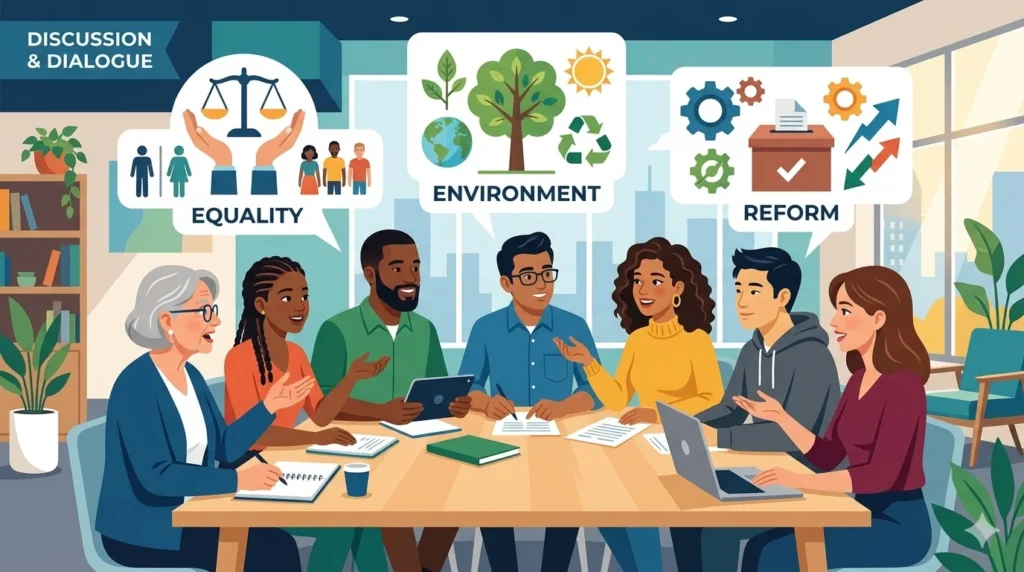

Progressive in politics refers to a set of ideas and movements that support social reform, equality, and government action to address economic and social issues. A progressive typically advocates policies that aim to improve fairness, expand rights, and adapt systems to meet modern needs.
Politics often comes with labels that sound familiar but are not always clearly understood. One of the most commonly used terms today is progressive. You may hear it in debates, news discussions, or campaign speeches, but what does it actually mean?
In simple terms, being progressive in politics is about pushing for change that improves society, especially in areas like economic fairness, social justice, and public welfare. However, the meaning can shift depending on context, country, and time period.
This guide breaks down what progressive means in politics, where the idea comes from, how it is used today, and how it compares to similar political terms. By the end, you will have a clear and practical understanding of the concept.
What Does Progressive Mean in Politics?
In political terms, progressive describes a person, ideology, or movement that supports forward thinking reforms.
More specifically, progressives tend to:
- Support policies that reduce inequality
- Advocate for expanded civil rights
- Promote government involvement in solving social problems
- Encourage modernization of laws and institutions
As a result, the term is often associated with efforts to create a more inclusive and fair society.
Origin and Historical Background
To understand the modern meaning, it helps to look at where the term began.
The Progressive Era
The word “progressive” became widely used during the Progressive Era in the late 19th and early 20th centuries, especially in the United States.
During this time, reformers pushed for:
- Labor protections
- Anti corruption laws
- Public health improvements
- Better working conditions
Notably, figures like Theodore Roosevelt played a key role in advancing progressive reforms.
How Progressive Is Used Today
Today, the meaning of progressive has evolved, but the core idea remains the same: supporting change to improve society.
Common Areas of Focus
Modern progressive politics often focuses on:
- Economic equality
- Healthcare access
- Education reform
- Climate action
- Social justice
For example, in the United States, politicians like Bernie Sanders and Alexandria Ocasio-Cortez are often described as progressive because of their policy positions.
Key Beliefs of Progressive Politics
Although views can vary, many progressives share similar core beliefs.
1. Social Equality
Progressives support equal rights regardless of race, gender, or background.
2. Active Government Role
In addition, they believe government should play a role in solving major social and economic issues.
3. Economic Fairness
They often support policies like higher minimum wages, worker protections, and fair taxation.
4. Environmental Responsibility
Many progressives advocate strong action on climate change and environmental protection.
5. Expansion of Rights
They also support expanding rights in areas such as healthcare, education, and voting access.
Examples of Progressive Policies
To make the concept clearer, here are some examples of policies often described as progressive.
- Universal healthcare systems
- Tuition free or affordable education
- Climate change regulations
- Criminal justice reform
- Expanded worker protections
While not all progressives agree on every issue, these ideas commonly appear in progressive platforms.
Progressive vs Other Political Terms
The term progressive is often confused with other political labels. However, there are important differences.
Comparison Table
| Term | General Meaning | Key Focus |
|---|---|---|
| Progressive | Reform and social change | Equality and modernization |
| Liberal | Individual rights and freedoms | Civil liberties |
| Conservative | Tradition and stability | Limited change |
| Moderate | Balanced or centrist views | Compromise |
Key Differences Explained
Progressive vs Liberal
Although they overlap, progressive ideas are often seen as more reform oriented and focused on systemic change.
Progressive vs Conservative
Progressives tend to favor change and reform, while conservatives usually prefer maintaining traditional systems.
Tone and Usage in Conversations
The word progressive can carry different tones depending on context.
Positive Tone 😊
- “She supports progressive policies that help working families.”
This suggests forward thinking and fairness.
Neutral Tone
- “The candidate identifies as progressive.”
This simply describes political alignment.
Critical or Negative Tone 😐
- “Some people think progressive policies go too far.”
In this case, the tone depends on opinion.
Because politics can be sensitive, tone matters when using the term.
Real World Usage Examples
Here are examples of how the word appears in everyday discussions.
- “He has progressive views on climate change.”
- “The party is moving in a more progressive direction.”
- “They support progressive reforms in education.”
These examples show how flexible the term can be.
Alternate Meanings of Progressive
Although this article focuses on politics, the word progressive has other meanings.
In general usage, it can mean:
- Gradually developing or improving
- Advancing step by step
- Supporting innovation or change
For instance, in everyday language, someone might say:
“A progressive approach to learning”
This broader meaning connects closely to its political use.
Polite or Professional Alternatives
In some situations, you may want to use alternative phrasing.
Here are a few options:
- Reform oriented
- Forward thinking
- Socially conscious
- Change focused
- Policy driven
These phrases can sound more neutral depending on the audience.
Common Misconceptions About Progressive Politics
Several misunderstandings surround the term.
“Progressive means the same everywhere”
In reality, the meaning can vary by country and political system.
“All progressives agree on everything”
In fact, there is a wide range of views within progressive movements.
“Progressive always means extreme”
Not necessarily. Some progressives hold moderate reform views.
When and How to Use the Term Progressive
Using the term correctly depends on context.
Best Situations to Use It
- Political discussions
- News analysis
- Academic writing
- Describing policy positions
Helpful Tips
- Provide context when possible
- Be aware of tone
- Avoid assuming agreement
- Use it accurately rather than as a label
Clear usage helps prevent confusion or misunderstanding.
Frequently Asked Questions
1. What does progressive mean in simple terms?
It means supporting change and reforms that aim to improve society.
2. Is progressive the same as liberal?
Not exactly. While they overlap, progressive ideas are often more focused on reform and structural change.
3. What do progressive politicians believe?
They typically support equality, social justice, and active government solutions.
4. Is progressive a positive or negative term?
It depends on perspective. Some view it positively, while others may disagree with progressive ideas.
5. Where did progressive politics start?
It became popular during the Progressive Era in the late 19th and early 20th centuries.
6. Do all countries use the term progressive the same way?
No. The meaning can vary depending on the political system and culture.
7. What are examples of progressive policies?
Examples include healthcare reform, climate action, and worker protections.
8. Can someone be moderate and progressive?
Yes. Some people hold a mix of views that include both moderate and progressive elements.
Conclusion
So, what does progressive mean in politics? At its core, it refers to supporting reforms that aim to create a fairer, more equal, and modern society.
To recap:
- Progressive politics focuses on change and improvement
- It has historical roots in reform movements
- It is widely used in modern political discussions
- Its meaning can vary depending on context
- Understanding it helps you follow political conversations more clearly
By learning how the term is used and what it represents, you can better understand debates, policies, and political viewpoints in today’s world.
Discover More Post
What Does PCT Mean in Football? Simple … – DefineHubs.com –
What Does Excluded Mean in PowerSchool – DefineHubs.com –
What Does TS Mean in Snapchat? Full … – DefineHubs.com –